If you open Twitter or LinkedIn right now, every self-proclaimed tech influencer is shouting about how AI is going to make developers obsolete. They'll show you a 30-second screen recording of a prompt generating a working landing page, call it the future of software engineering, and try to sell you a subscription or a PDF course.
But if you are actually trying to learn how to program right now, this hype is quietly ruinous.
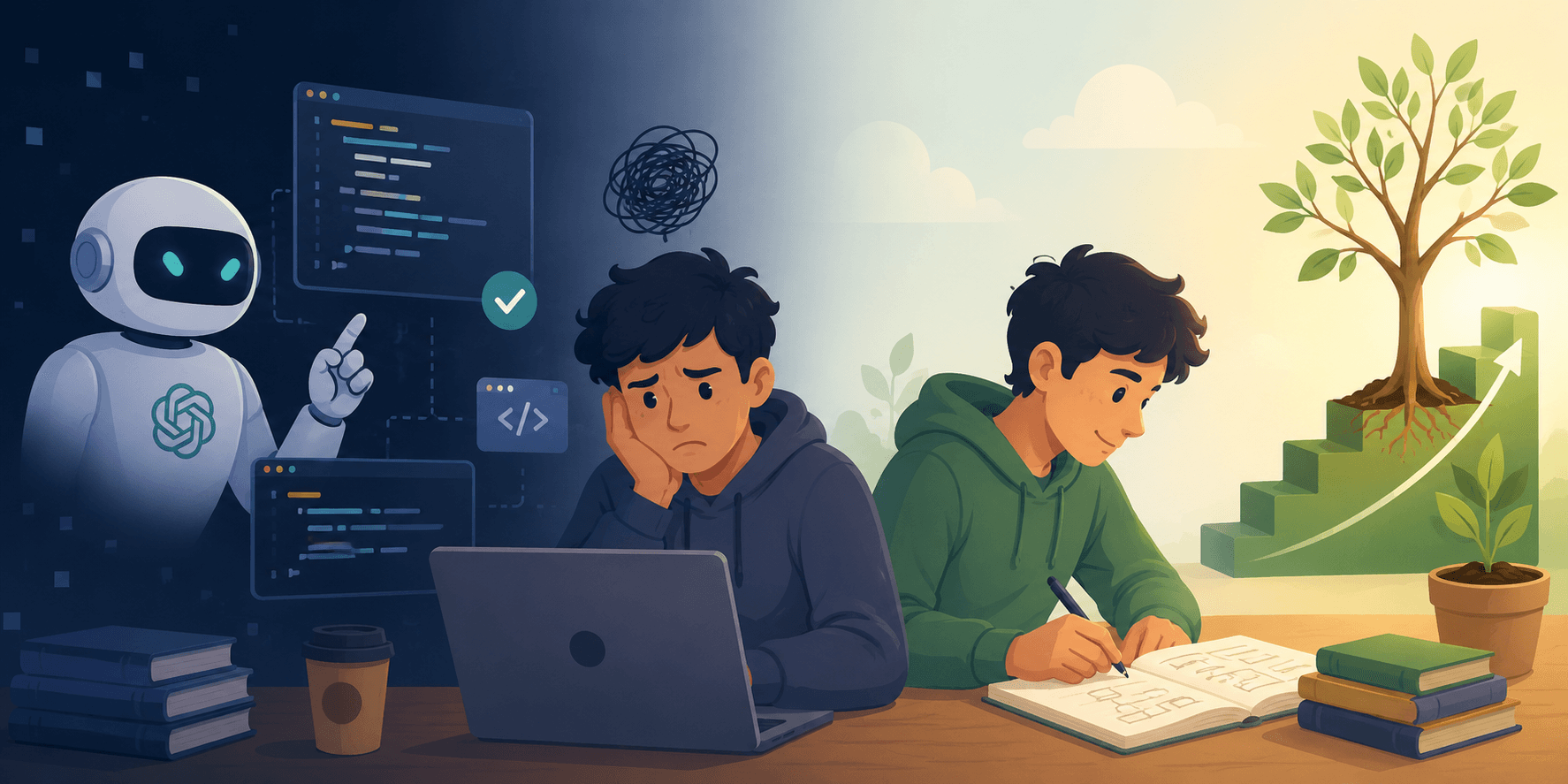
Prompting ChatGPT to spit out a clean Next.js component is not coding. It’s ordering takeout. And if you spend your entire first year of learning just placing orders, you are not building a valuable developer skill. Instead, you are building a massive dependency on a tool you do not understand.
For experienced engineers, AI coding tools are a superpower for wiping out boilerplate. But for beginner programmers, relying on AI too early is a major trap. Let’s talk about why this shortcut is holding you back, and how to change how you talk to AI so it actually helps you grow instead of keeping you dependent.
The False Confident High of Copy-Paste Coding
When you are starting out, getting code to compile is a massive hurdle. So when ChatGPT spits out 50 lines of perfect React code and your browser magically renders exactly what you wanted, your brain gets a massive hit of dopamine. You feel like an absolute genius.
But it’s a total lie.
There is a massive difference between *recognizing* how a piece of code works when it is handed to you, and *retrieving* that logic from your own brain to build it from scratch. In psychology, this is called the illusion of competence. You think you know how to build a state machine or configure a database helper because you have seen ChatGPT do it ten times. But the second you open a blank VS Code window without an internet connection, your mind goes completely blank. You do not actually know the concepts; you just know how to recognize the correct answer when someone else serves it to you.
Where the Quick Fix Quietly Backfires
If you let an AI make all your micro-decisions, you bypass the exact mental friction that makes you a valuable developer. Here is what is actually happening when you rely too heavily on the quick copy-paste:
Your debugging reflex never develops
Writing new code is about 20% of a developer's job. The other 80% is debugging. It’s spending hours staring at a broken console log, tracing a variable through three different files, and finally realizing you misspelled a variable name. That process is incredibly frustrating, but it is exactly where real learning happens. It builds a mental map of how data moves. If you copy-paste every error back into ChatGPT, you never build that internal compass. The second the AI starts hallucinating and suggesting incorrect loops, you are completely dead in the water.
You end up stitching together spaghetti code
AI is fantastic at writing isolated snippets. But it has absolutely no long-term memory of your entire system architecture. When a beginner asks ChatGPT for a component, then asks it for a database helper, then asks it for an auth wrapper, they end up with three pieces of code that technically run but are completely mismatched under the hood. It’s like building a house with a kitchen from a spaceship, a living room from a medieval castle, and a bathroom from a submarine. The moment you need to scale or fix a bug, the whole thing collapses because there was no cohesive architecture.
You become a hostage to the prompt
If you never struggle to remember standard syntax, library APIs, or configuration settings, your brain never actually stores them. You become a proxy developer. Your actual skill isn't coding; it is simply translating human requests into prompt syntax. If OpenAI's servers go down, or if a company expects you to write a coding challenge on a physical whiteboard in a job interview, you are completely paralyzed.
7 AI Skills Dominating the Tech Job Market by 2027
Coding is changing fast, and AI is here to stay. Discover which specific AI engineering and prompt design skills will secure your placements in 2026/2027 and keep you ahead of the curve.
Read AI Skills Guide →AI Prompts vs. The Heavy Lifting of Real Learning
Let’s look at what you are actually trading away when you choose short-term speed over long-term depth:
| Focus Area | Relying on AI | Active Learning |
|---|---|---|
| First Working App | Built in 1 hour (clueless) | Took 3 days (fully understood) |
| Handling Complex Bugs | Frustrating, looping prompts | Methodical console logging & fix |
| Reading Docs | Avoided entirely | First source of truth |
| Career Growth | Hits a hard ceiling fast | Infinite scaling potential |
How to Make AI Your Mentor (And Not Your Crutch)
You don't need to quit AI cold turkey. Knowing how to use it is a massive advantage in today's landscape. But you have to change *how* you talk to it. Here is the ruleset you should adopt today:
- 💡Never ask for code. Ask for concepts.Instead of prompting, "Write a Next.js API route that handles a Stripe checkout web hook," try: "Explain the lifecycle of a Stripe webhook. What security headers do I need to verify, and how does the signature handshake work step-by-step?" Once you understand the flow, write the code yourself.
- 🔍Treat snippets like a foreign language translation.If you absolutely must generate a block of code, do not copy-paste it blindly. Read every line. If you see a method, utility function, or parameter you don't recognize, highlight it and ask the AI: "Why did you use this method instead of a standard array mapper? What does this parameter actually control?" If you can't explain what every line does to a peer, don't commit it.
- 📝Adopt the 30-Minute Struggle Rule.When you run into a bug or don't know how to build a feature, do not immediately open ChatGPT. Spend at least 30 minutes reading the official docs, adding console logs, and trying to debug it yourself. If you still can't solve it, ask the AI, but make sure to explain what you've already tried and ask it to point out the gap in your logic, rather than just rewriting the file.
Best AI Tools for Students (Free & Actually Useful)
Struggling to keep up with university practicals, notes, and homework? Explore our complete breakdown of free, powerful AI tools that will save you time without cheating your education.
Explore Student AI Tools →The Hard Truth About Coding Growth
🏋️♂️ The push-up analogy:
Coding is like going to the gym. You can pay someone else to do your pushups for you, but you're not the one who is going to get stronger. The friction, the frustration, the hours spent staring at a screen trying to figure out why a promise resolves to undefined... that friction is the actual learning.
Master the fundamentals. Get your hands dirty. Build things that break, and fix them with your own hands. Once you actually know what's going on under the hood, you can use AI to build ten times faster. But until then? Close the chat window, open the docs, and start writing real code.
Join Our Reddit Communities!
Official HubsGet direct student support, live feedback, traffic hacks, and daily AI workflow blueprints.
r/GrowMyBlogs 📈
BLOGGING & SEOWant the latest updates, site audits, and discussions? Share your blog, get SEO advice, and grow your online presence alongside other creators.
r/AIToolDaily 🤖
AI & HACKSStay ahead of the curve! Discover daily student-tested AI tools, syllabus hacks, assignment automation, and smart career workflows.
We post daily
Don't miss the next result update
Results drop without warning. Follow us and you'll know the moment it's out — before you even think to Google it.
Zero spam. Just results, cut-offs, and stuff that actually matters.